
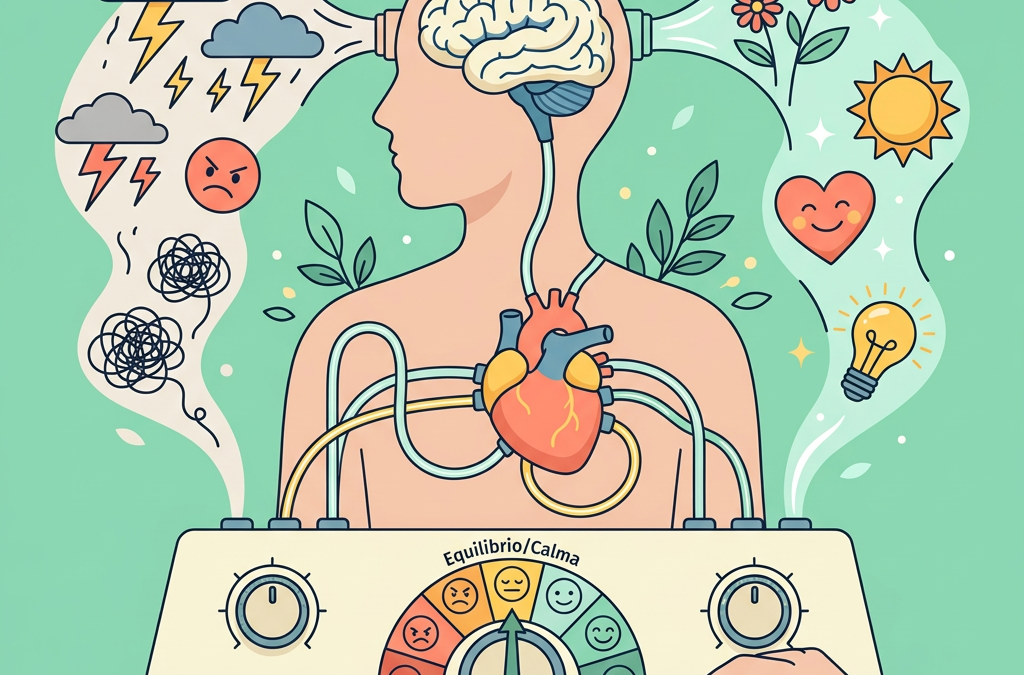
Emotional management: learn to understand and regulate your emotions in Fuengirola
The Emotional management in Fuengirola and Mijas Es una habilidad fundamental para mantener el bienestar psicológico, afrontar las dificultades de la vida y construir relaciones saludables. Todas las personas experimentamos emociones agradables y desagradables, pero no siempre sabemos cómo identificarlas, comprenderlas o gestionarlas de manera adecuada.
At CALMA Psicólogos, we help children, adolescents, and adults develop effective tools to understand their emotions, reduce emotional suffering, and improve their quality of life through personalised professional support.
Recommended reading First visit to the psychologist: What to tell, what to expect
Emotional management is the ability to understand, process, and express emotions in a healthy and constructive way.
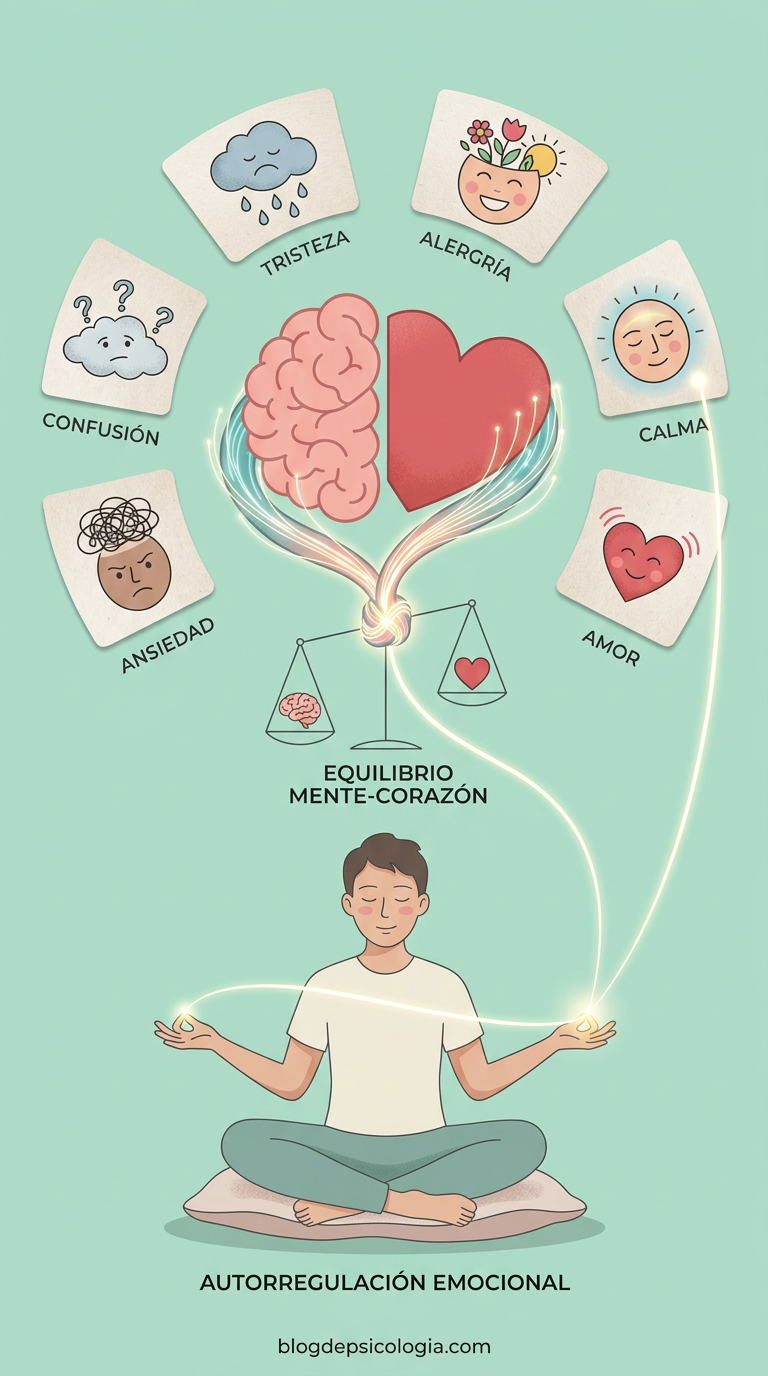
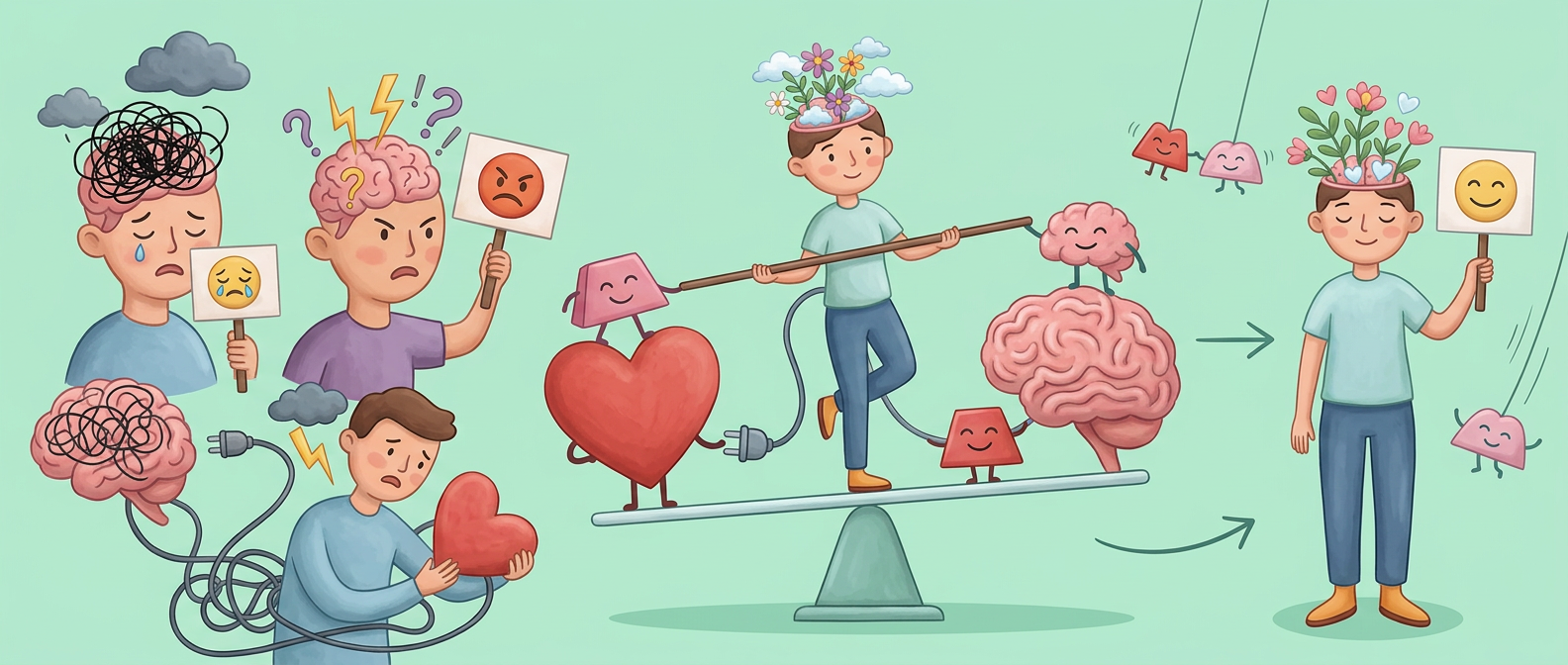
Emotional management is the ability to recognise, understand, accept, and regulate our emotions in an adaptive way. It does not involve avoiding unpleasant emotions or trying to eliminate them, but rather learning to relate to them in a healthy manner.
When we develop good emotional management, we are able to:
- To identify what we feel.
- Understanding the origin of our emotions.
- Expressing our emotions appropriately.
- Making more conscious decisions.
- Maintain more satisfying relationships.
- Facing difficult situations with greater resilience.
Emotional management involves accepting that all emotions serve an important function, and that even those that cause discomfort can provide us with valuable information about our needs.
Curiosities: 7 types of anxiety
Emotional management is crucial for several reasons. It helps us understand and control our feelings, which in turn allows us to respond to situations in a healthier and more constructive way. This ability can improve our relationships with others, as it enables us to communicate our needs and feelings effectively and to empathise with those around us. Furthermore, good emotional management is essential for our mental and physical well-being, as prolonged stress and negative emotions can lead to health problems. It also plays a vital role in our personal and professional development, as it helps us to set goals, overcome challenges and make better decisions.
Emotions are part of every aspect of our lives. They influence how we think, act, relate to others, and make decisions.
Effective emotional management allows for:
- Coping with stressful situations more effectively.
- Better adapt to life changes.
- Improve self-esteem and self-confidence.
- Reduce anxiety and stress levels.
- Prevent interpersonal conflicts.
- To promote greater emotional stability.
- To increase psychological well-being.
Conversely, when there is significant difficulty in managing emotions, problems such as anxiety, depression, impulsivity, relationship conflicts, or a sense of emotional uncontrol can arise.
Curiosities: The importance of the therapeutic alliance
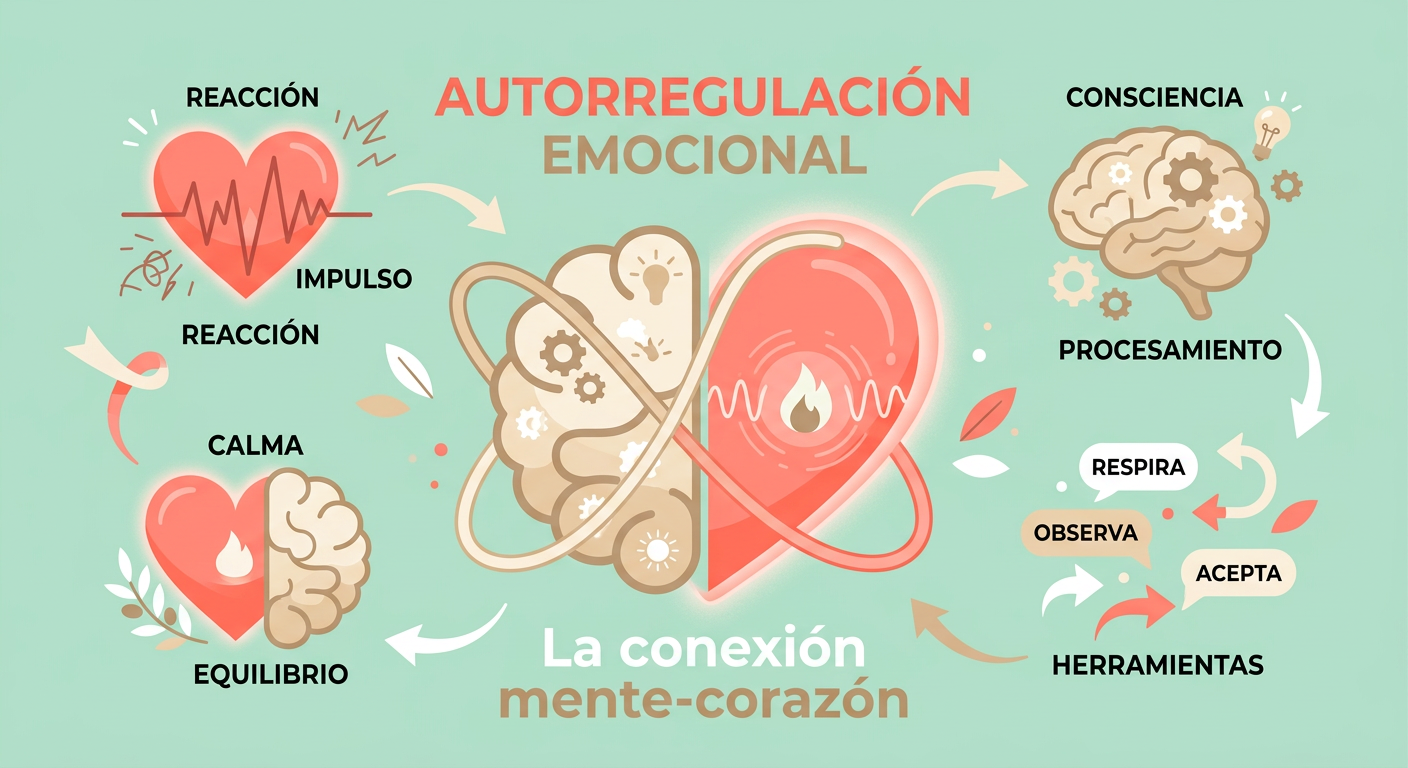
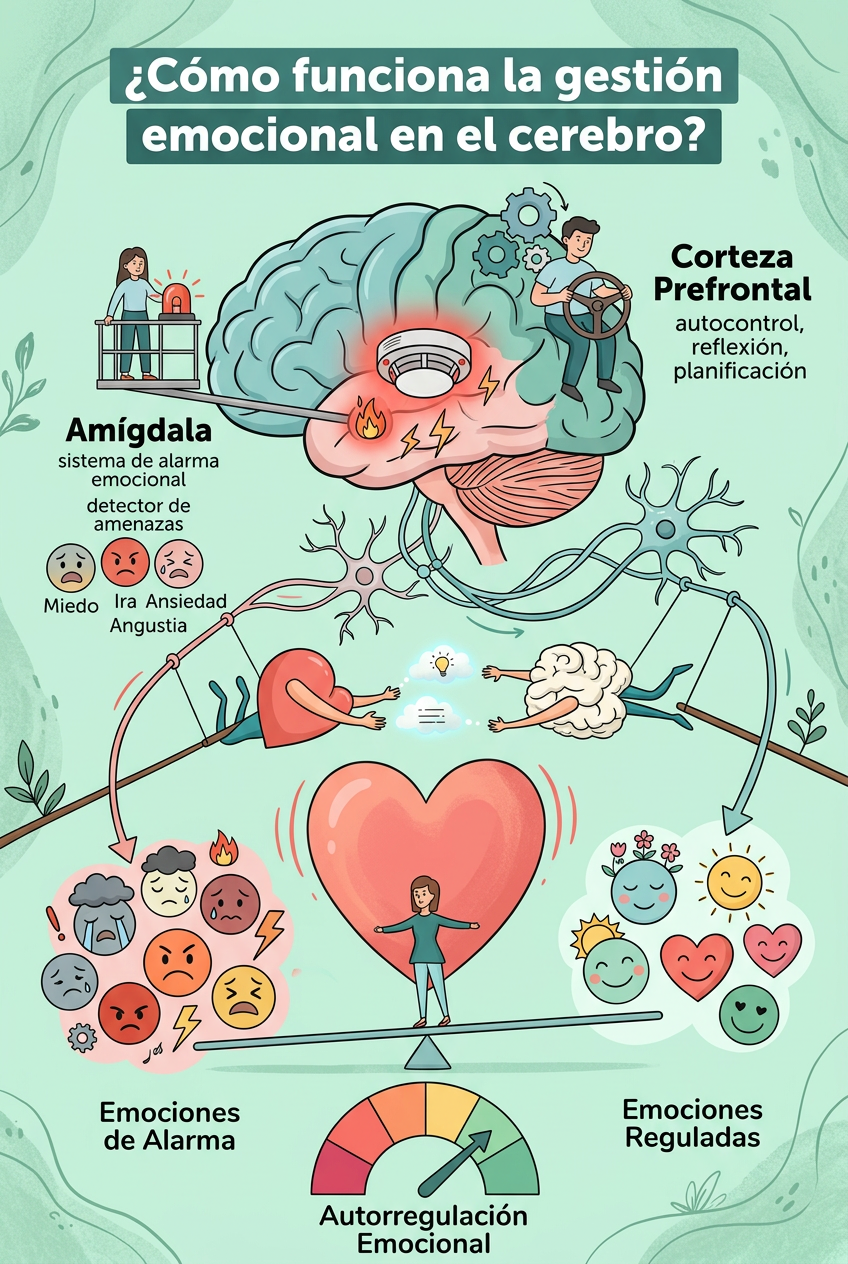
How does emotional management work in the brain?
Emotional regulation involves the interaction of different brain areas working together to help us respond to events in our environment.
The amygdala: our emotional alarm system
The brain's amygdala acts as a threat detector. Its function is to react quickly to situations that it perceives as dangerous or emotionally relevant.
When intensely activated, emotions such as:
- Fear.
- Rage.
- Anxiety.
- Anguish.
The prefrontal cortex: the centre of emotional regulation
The prefrontal cortex participates in:
- Reflection.
- Planning.
- Decision-making.
- Self-control.
Thanks to this structure, we can analyse what we feel and decide how to respond more adaptively.
When emotion is too intense, what Daniel Goleman termed an «emotional hijacking» can occur, an impulsive reaction in which emotion temporarily takes control.
The good news is that emotional management can be trained and strengthened through practice and appropriate psychological support.
How do we learn to manage emotions?
The ability to regulate emotions begins to develop from infancy.
Children learn to understand their emotional states thanks to the presence of role models who help them identify, name, and manage what they feel.
When an adult responds sensitively and empathetically to a child's emotions, the child progressively learns to:
- Recognise your emotions.
- Tolerate discomfort.
- Regulate your behaviour.
- State your needs.
For this reason, many emotional difficulties in adult life can be related to early experiences where these skills were not adequately developed.
Emotional management strategies
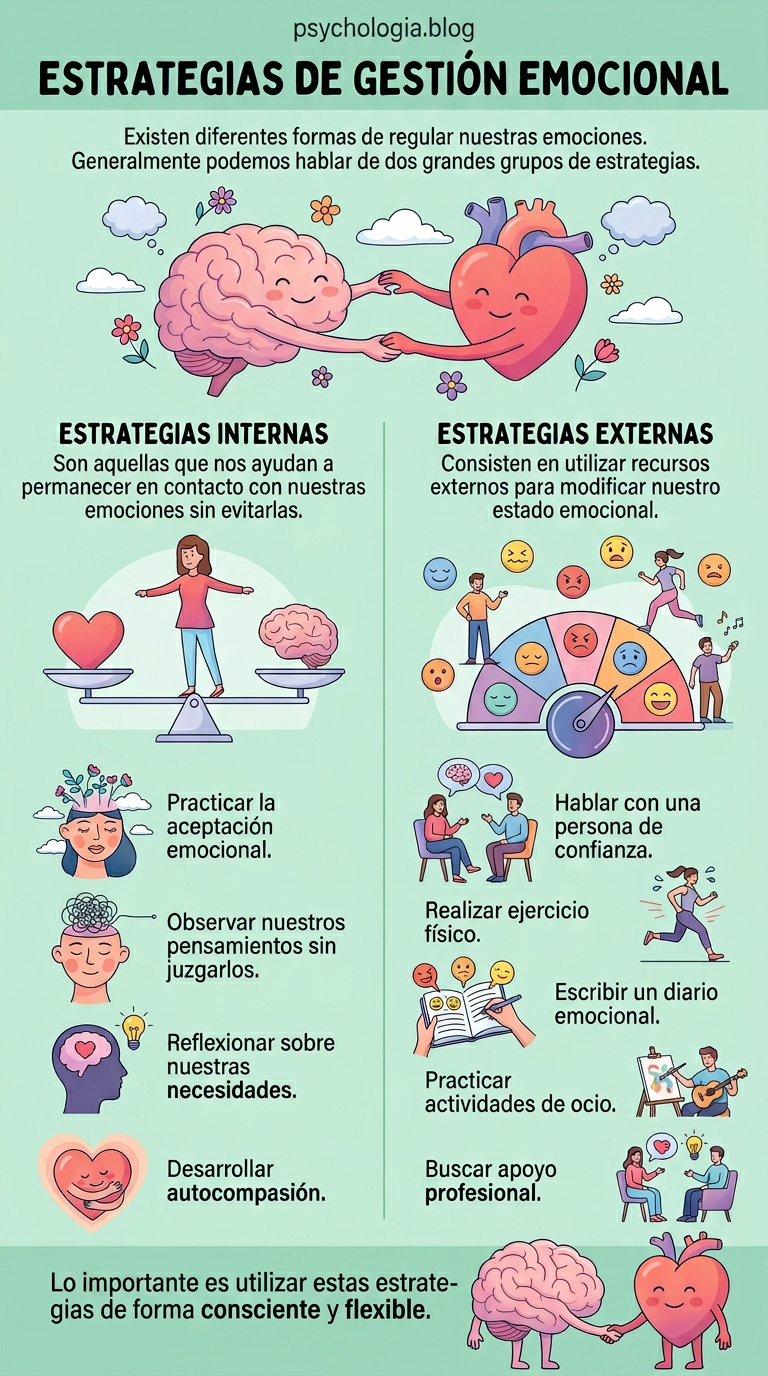
There are different ways to regulate our emotions. We can generally talk about two broad groups of strategies.
Internal strategies
These are the ones that help us stay in touch with our emotions without avoiding them.
For example:
- Practise emotional acceptance.
- Observe our thoughts without judging them.
- To reflect on our needs.
- Develop self-compassion.
External strategies
They consist of using external resources to modify our emotional state.
Here are some examples:
- Talk to a trusted person.
- Do physical exercise.
- Write an emotional diary.
- To practice leisure activities.
- Seek professional support.
The important thing is to use these strategies flexibly, avoiding an exclusive reliance on a single form of emotional regulation.
Signs of poor emotional management
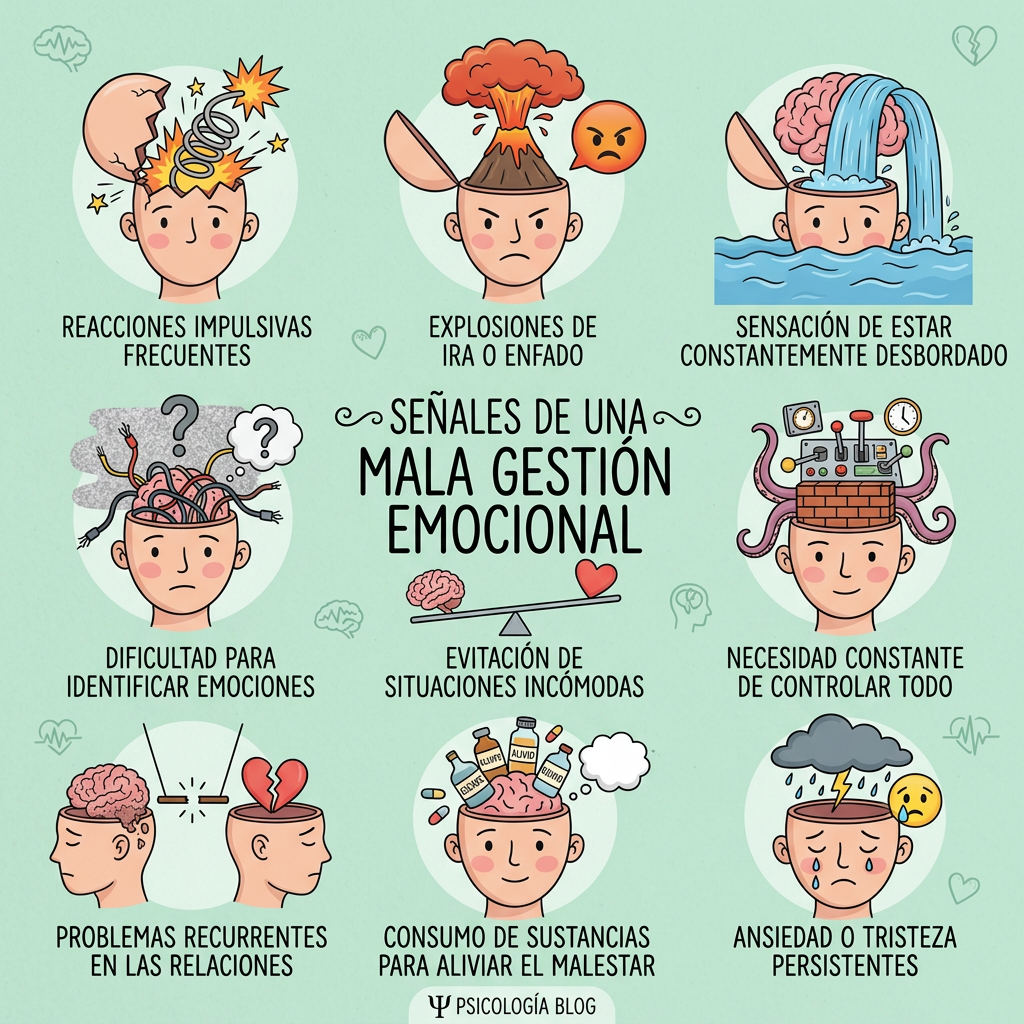
Some signs that can indicate difficulties in emotional management are:
- Frequent impulsive reactions.
- Outbursts of anger or rage.
- Feeling constantly overwhelmed.
- Difficulty identifying emotions.
- Avoiding awkward situations.
- Constant need to control everything.
- Recurring problems in relationships.
- Substance use to alleviate discomfort.
- Persistent anxiety or sadness.
If these difficulties are interfering with your well-being or daily life, it may be advisable to seek specialised psychological support.
Techniques for improving emotional management
The Emotional management in Fuengirola and Mijas It is possible to work effectively in psychological therapy using evidence-based tools.
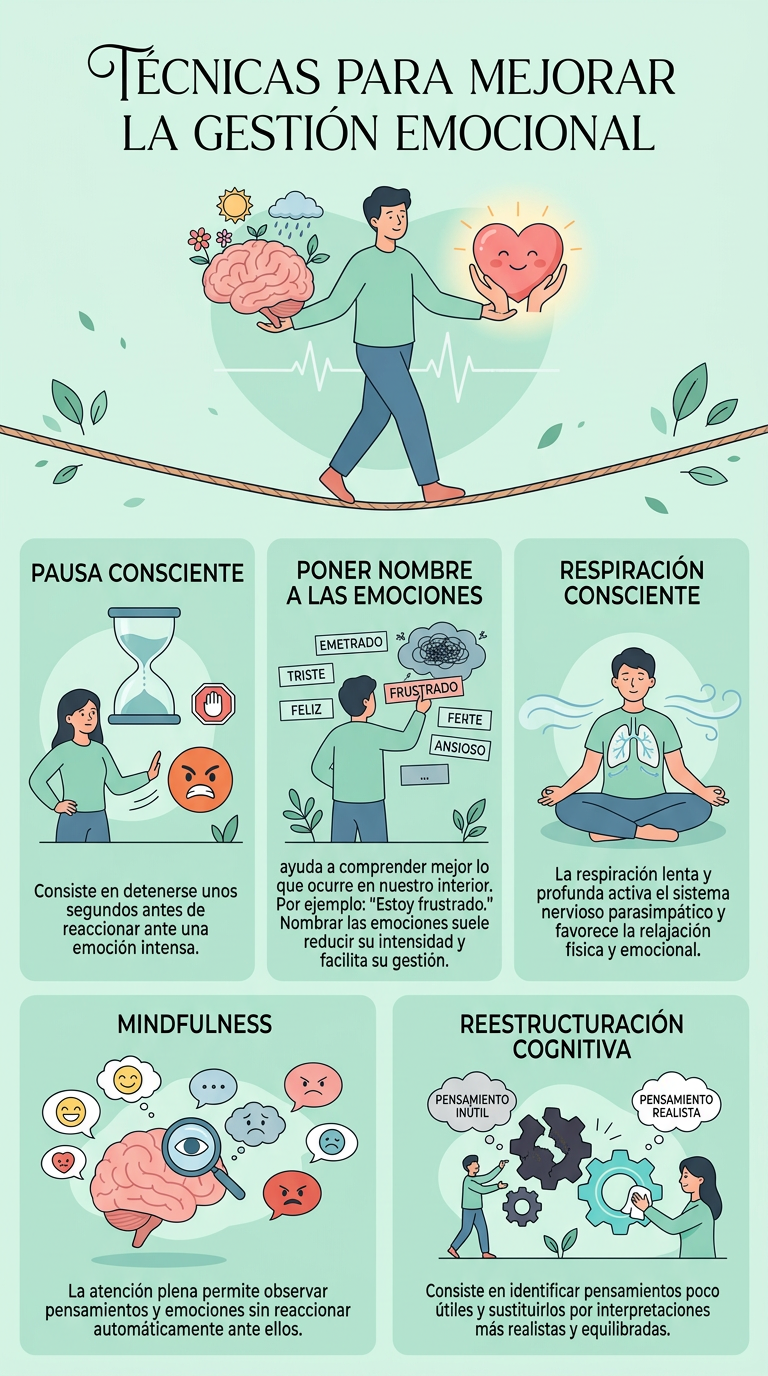
Mindful pause
It involves pausing for a few seconds before reacting to an intense emotion.
This technique allows:
- Reduce impulsivity.
- Take perspective.
- Choose more adaptive answers.
Emotional identification
Giving names to emotions helps us to better understand what is happening within us.
For example:
- «I'm frustrated.»
- «I feel disappointed.»
- «I'm scared.»
Naming emotions usually reduces their intensity and makes them easier to manage.
Mindful breathing
Slow, deep breathing activates the parasympathetic nervous system and promotes physical and emotional relaxation.
Mindfulness
Mindfulness allows for observing thoughts and emotions without automatically reacting to them.
Various studies have shown benefits of mindfulness in reducing anxiety, stress, and emotional reactivity.
Cognitive restructuring
It involves identifying unhelpful thoughts and replacing them with more realistic and balanced interpretations.
Emotional management and personal relationships
The way we manage our emotions directly influences our relationships.
When we develop appropriate emotional skills:
- We communicate our needs better.
- We listen with greater empathy.
- We resolve conflicts more healthily.
- We reduce impulsive arguments.
- We strengthen emotional bonds.
Emotional regulation is one of the fundamental pillars of satisfying romantic, family, and social relationships.
Emotional management and decision making
Emotions constantly influence our decisions.
When we are overwhelmed by intense emotions such as anger, fear, or anxiety, we may act impulsively and make decisions that we later regret.
Effective emotional management allows for:
- Analyse situations with greater clarity.
- Evaluate different options.
- Consider the consequences of our actions.
- To act in accordance with our values and objectives.
Cuando necesites mejorar tu gestión emocional, la terapia puede ser de gran ayuda.
It may be advisable to see a psychologist when:
- You often feel overwhelmed by your emotions.
- Do you experience constant anxiety or stress?.
- You have difficulty controlling your anger.
- You avoid situations for fear of emotional discomfort.
- Your personal relationships are affected.
- You struggle to identify or express what you feel.
- You experience intense and frequent emotional changes.
Psychological therapy offers a safe space to better understand your emotions and develop effective strategies for managing them.
Emotional Management at CALMA Psicólogos
Take the first step towards your emotional well-being.
Learning to manage emotions doesn't mean stopping feeling, but rather developing the ability to understand what's happening in our inner world and respond in a healthier way.
If you feel you need support to improve your emotional regulation, at CALMA Psicólogos we work on Emotional management in Fuengirola and Mijas from a close, individualised, and scientifically-based approach.
Our aim is to help you to:
- Understanding your emotions.
- Develop emotional regulation tools.
- Improve your psychological well-being.
- Reduce anxiety and stress.
- Boost your self-esteem.
- Build healthier relationships.
We offer face-to-face psychological support in Fuengirola and Mijas, as well as online therapy for those who prefer to receive support from anywhere.
Post written by Samara Valenzuela
If, after reading this entry, you believe you may need therapy and would like to learn more about the professionals who provide it at CALMA PSICOLOGOS, do not hesitate to click.
Bibliographical references
- Baldwin, M., Dorison, C. A., Stavrova, O., et al. (2025). Research on emotion regulation repertoires and psychological well-being.
- Bion, W. R. (1962). Learning from Experience. London: Heinemann.
- Goleman, D. (1995). Emotional intelligence. Barcelona: Kairós.
- Hayes, S. C., Strosahl, K. D., & Wilson, K. G. (2016). Acceptance and Commitment Therapy: The Process and Practice of Mindful Change. Guilford Press.
- Linehan, M. M. (2015). DBT Skills Training Manual. Guilford Press.
- Zhang, Y., et al. (2022). Effects of mindfulness-based emotional regulation interventions on anxiety, mood and resilience in university students.
- Gross, J. J. (2015). Emotion Regulation: Current Status and Future Prospects. Psychological Inquiry, 26(1), 1–26.
- American Psychological Association (APA). Emotional Regulation Resources.
- World Health Organization (WHO). Mental Health and Emotional Wellbeing Resources.
-